









































































































































































































































































































Text Messages Reveal Details of Adelabu–Ayodele ‘Spiritual Intercession’ Dispute

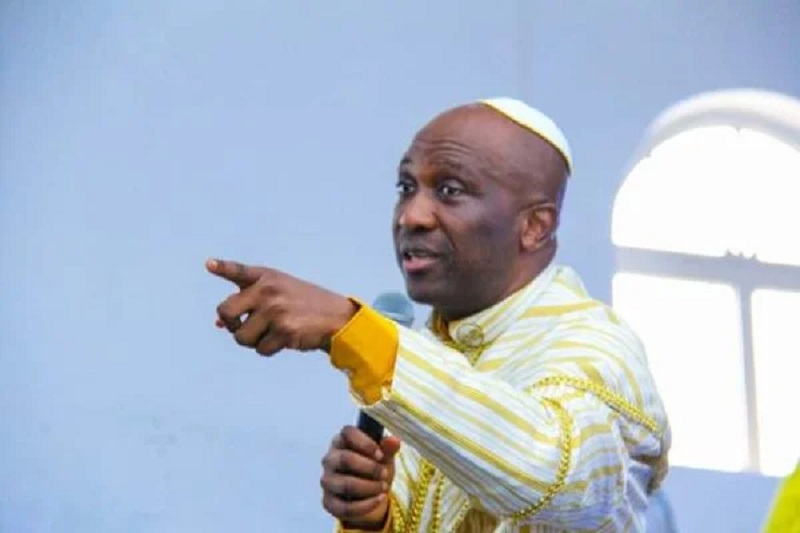
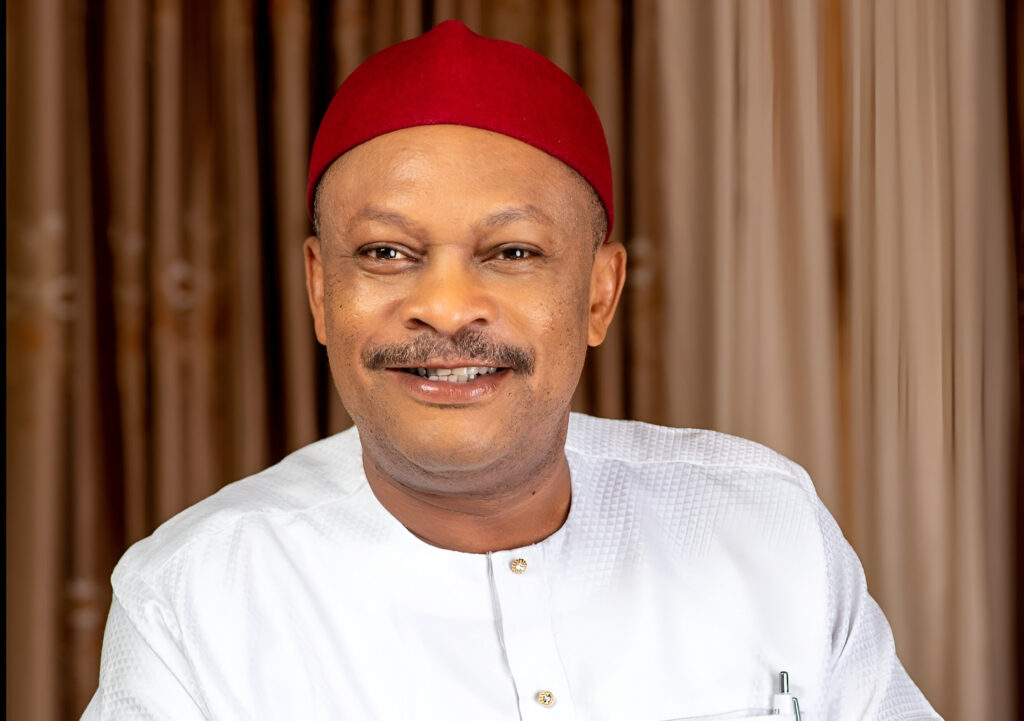
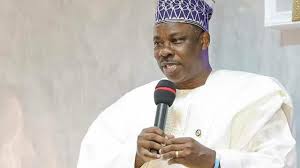
Fresh details have emerged in the dispute between the Minister of Power, Mr. Bayo Adelabu, and the Founder and Head of INRI Evangelical Spiritual Church, Primate Elijah Ayodele, following the release of text messages exchanged by both men, which appear to detail repeated requests for political and ritual items ahead of the Oyo State governorship race.
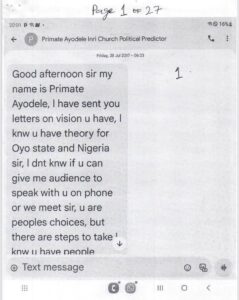
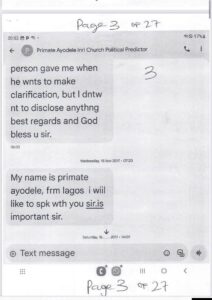
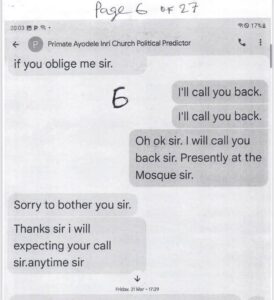
The messages, spanning several years and obtained by Outlook Nigeria, form the core of Mr. Adelabu’s petition to the Department of State Services (DSS), in which he accused the cleric of blackmail and an attempt to extort up to ₦150 million under the guise of “spiritual intercession” to secure electoral victory.
In the messages, Primate Ayodele persistently sought access to Mr. Adelabu, claiming to have written several letters to him during his tenure as Deputy Governor of the Central Bank of Nigeria (CBN) and later while he served in public office, without receiving a response. He repeatedly requested phone conversations and meetings, describing his outreach as “divine advice” sent by God.
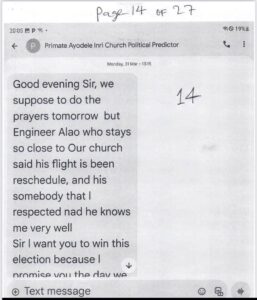
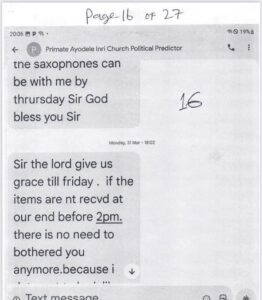
At a critical point in the exchange, the cleric explicitly linked spiritual prayers to the provision of items, including party flags, campaign posters, and musical instruments, which he said were necessary to “claim victory” in the election.
In one message, Primate Ayodele wrote that Mr. Adelabu would “rule Oyo State” and instructed him to embark on a vigil, stating:
“Today do vigil, the angel of God is coming to hear request by 1am… lastly I am expecting the items requested to claim your victory mandate for you on or before 1st of April”.
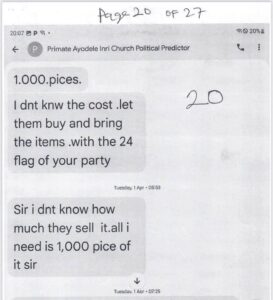
The cleric specifically demanded 23 or 24 flags of the minister’s political party, alongside 1,000 saxophones or trumpets, insisting that the items be delivered by an initially fixed deadline of 1 April, later extended to 4 April.
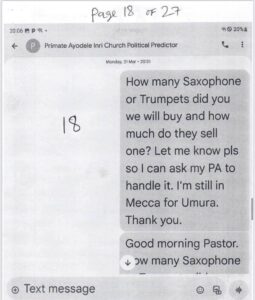
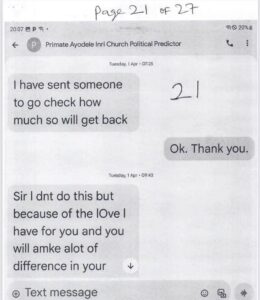
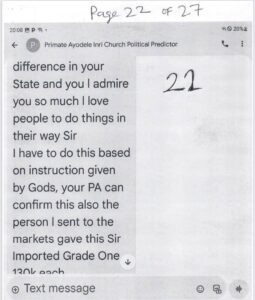
While Mr. Adelabu was on pilgrimage in Mecca, he sought clarification on the quantity and cost of the instruments, stating in a message that he would ask his personal assistant to handle the matter. In response, Primate Ayodele provided a detailed price breakdown sourced from Alaba Market, Lagos, listing costs that ranged from ₦50,000 per fairly used Nigerian instrument to ₦130,000 per imported grade-one trumpet, putting the total cost at between ₦50 million and ₦130 million.
“I don’t do this, but because of the love I have for you… I have to do this based on instructions given by God,” the cleric wrote while forwarding the prices.
In his response, Mr. Adelabu expressed shock at the financial implications, stating plainly that he could not afford such sums for prayers. He noted that even the cheapest option would amount to ₦50 million, adding that his governorship ambition was rooted in service, not personal enrichment.
“Where do you think I will get that kind of money for prayers? My governorship ambition is to serve my state and the people, not to make money,” the minister wrote, while appealing instead for prayers without financial conditions.
Following his refusal to provide the items, Primate Ayodele later declared publicly that Mr. Adelabu had “failed” and would not become governor of Oyo State, describing his earlier messages as divine warnings. In video sermons circulated online, the cleric challenged the minister to arrest or sue him.
However, Primate Ayodele has denied any attempt to extort money from the minister. In a statement issued through his media aide, Mr. Osho Oluwatosin, he maintained that he never demanded cash, insisting that the request for trumpets was spiritual guidance rather than extortion. He argued that Mr. Adelabu initiated the discussion about costs and sent intermediaries to him out of “desperation” to secure the governorship ticket.
The cleric further claimed that his prophecies regarding Mr. Adelabu’s political future predated the exchange of messages and were not influenced by the minister’s refusal to procure the instruments.
As investigations continue, the emergence of the text messages has added documentary weight to the controversy, transforming what began as a war of words into a dispute anchored in written exchanges that now form part of a formal security petition.
The Text Messages: